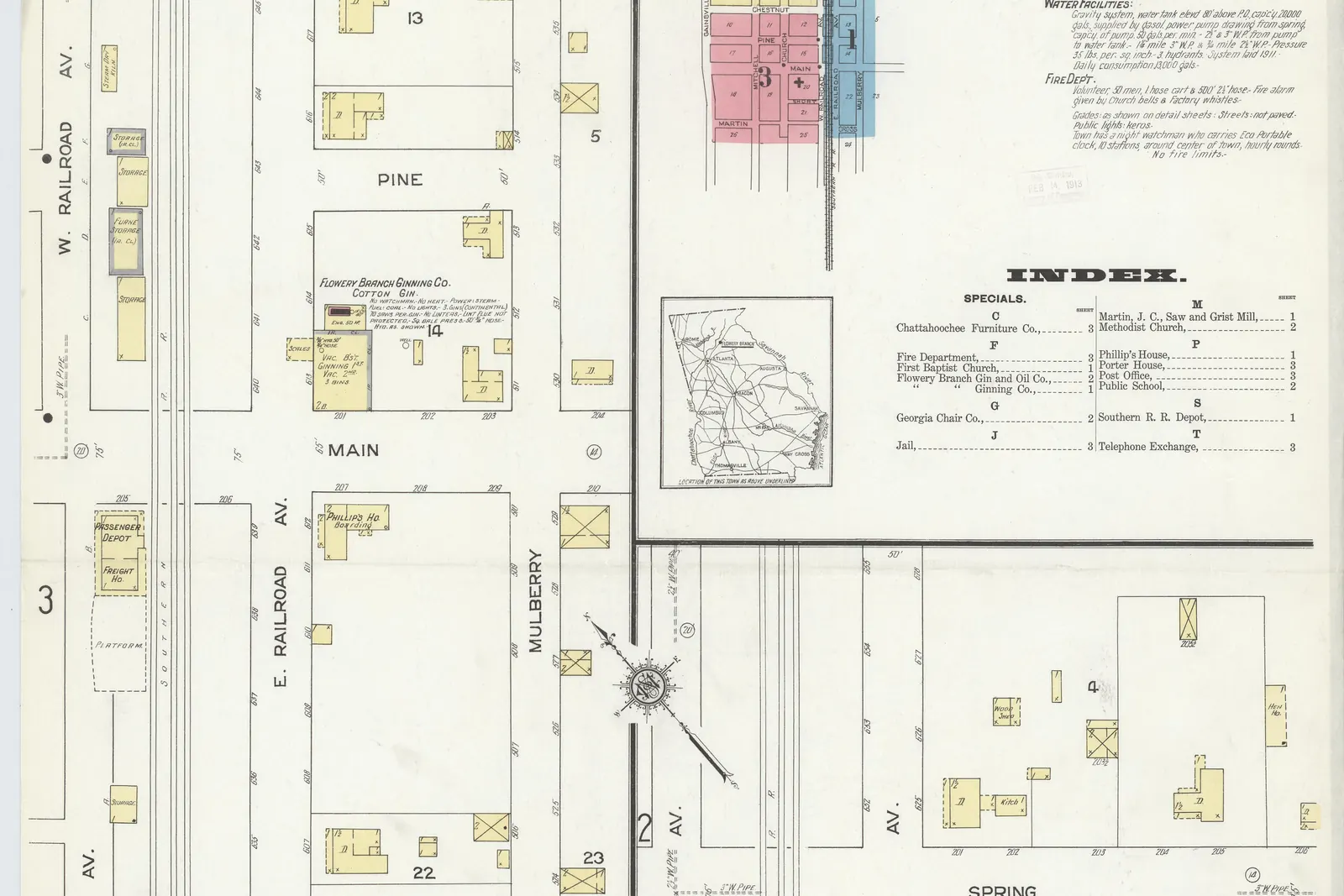
The depot at the corner of Railroad Avenue and Main Street is the building most people picture when they think of downtown Flowery Branch. Its story has a few turns that the usual one-line summary leaves out: a date that changed when someone opened a wall, a sale price of one dollar, and a move across the street. We have pieced it together from the City’s depot history, the 2010 plaque on the building and the New Georgia Encyclopedia.
Which is older, the railroad or the town?
The railroad. The City’s depot history says the line was first conceived in 1858 by the Georgia Airline Railroad and was built in 1873 from Atlanta to Charlotte. The City says Flowery Branch was established in 1874, a year later. The New Georgia Encyclopedia agrees on 1874 as the founding of a railroad stop and gives 1903 as the year the town was incorporated.
Sources name the railroad differently. The City’s history page calls it the Richmond and Danville Air-Line Railroad. The encyclopedia calls it the Atlanta and Richmond Air Line, later Norfolk Southern. The plaque names the Richmond & Danville Railroad and the Southern Railway System. We name the source each time rather than pick one name.
Why do some sources say 1901 and others 1890?
For years the depot was thought to date from 1901. Then, during the restoration, workers found bills of lading dated 1890 and 1891 inside the freight room wall. Bills of lading are shipping receipts, and a building does not collect receipts before it exists. The City’s timeline now lists 1890 as the year the depot was built.
The older date has not vanished from every City page. The City’s facility rentals page still refers to the rehabilitation of the original 1901 building. We use 1890, because the depot history page explains how that date was found.
- The depot was long thought to date from 1901, but workers restoring it found bills of lading dated 1890 and 1891 in the freight room wall. The City's timeline lists 1890 as the year the depot was built. City of Flowery Branch: Historic Train Depot
What did the depot handle?
Cotton, above all. The City says Flowery Branch was known as the town where “Cotton was King,” where Northeast Georgia farmers brought their crops to be ginned, sold and shipped by rail. Later, businesses that depended on the railroad made furniture, leather goods and buggies. The encyclopedia says the cotton market declined in the 1920s.
When did trains stop stopping?
Scheduled train stops at Flowery Branch ended in 1957. After that the depot was a flag stop, where a train would halt on request, until the late 1960s. The City says the train no longer stops in Flowery Branch, though trains still run through. You can see them along the water at Bay Park.
How did the City buy a depot for a dollar?
The plaque on the building, placed in 2010 by Friends of the Depot, Flowery Branch, Georgia, Inc. and Flowery Branch Better Hometown, Inc., says the depot was sold to the City for $1.00 in 1972. The City’s own depot page does not mention the sale, so the plaque is our source for it. The plaque does not say who sold it.
A dollar bought the building, not a finished museum. The plaque says the depot was rehabilitated with federal Transportation Enhancement funds through the Georgia Department of Transportation and dedicated in 2001 as a museum and community center.
- The depot plaque says the building was sold to the City for $1.00 in 1972, rehabilitated with federal Transportation Enhancement funds through the Georgia Department of Transportation, and dedicated in 2001 as a museum and community center at 5302 Railroad Ave. Read The Plaque: transcription of the 2010 Flowery Branch Depot plaque
Where did the depot stand before 2000?
Across the street. In April 2000 the depot was moved from beside the tracks to its present spot at the corner of Railroad Avenue and Main Street, and the restoration was completed in 2001. The City’s pages do not say why it was moved, and we will not guess. Today’s address is 5302 Railroad Ave., the one the plaque and the City’s rentals page use.
What is milepost 594?
Walk just north of the depot to the track and look for Railroad Marker #594. The City says it marks the spot as 594 miles from Union Station in Washington, D.C. It is easy to walk past, so look for it beside the track.
What is the depot used for now?
The City describes it as a community center and museum that hosts weddings, receptions and meetings. The encyclopedia adds welcome center to that list. The City rents it for up to 80 seated at tables and 135 people in all, or up to 250 when booked together with the market pavilion; rentals go through the Department of Fun. During Stars, Flannel & Vintage Weekend on Friday, Oct. 23, 2026, the City holds craft classes inside.
We could not find published museum hours. Call City Hall at 770-967-6371 before you plan a visit around going inside. A historic caboose at the north end of Main Street, visible from Atlanta Highway (SR 13), also serves as a museum, by the City’s account.
Is the depot part of a historic district?
Yes, two kinds. The Flowery Branch Commercial Historic District, at Main Street and Railroad Avenue, is in the National Register of Historic Places; the National Park Service record is dated Aug. 30, 1985. Downtown is also a local historic district, and the City’s Historic Preservation Commission reviews exterior changes. A material change needs a Certificate of Appropriateness. Paint color does not.
For the longer story, from the Anaguluskee name onward, see our history page. To walk the depot, the caboose and Main Street in one loop, use our Main Street guide.
History questions
Where does the name Flowery Branch come from?
Before the railroad came through, the area was known as Anaguluskee. The City translates the name as "flowers on the branch," and the New Georgia Encyclopedia calls it a Cherokee word meaning "flowers on the branch," with branch meaning a stream. The English name Flowery Branch comes from that meaning.
Source: City of Flowery Branch: History
When was Flowery Branch founded?
The City says Flowery Branch was established in 1874, one year after a rail line was built through the area between Atlanta and Charlotte. The New Georgia Encyclopedia agrees that the town was founded in 1874 as a railroad stop, and it gives 1903 as the year the town was incorporated.
Source: City of Flowery Branch: History
What is the historic depot?
The Flowery Branch depot is a railroad station the City dates to 1890, based on bills of lading found in its freight room wall. Scheduled train stops there ended in 1957. The building was moved across the street in April 2000 to the corner of Railroad Avenue and Main Street, and its restoration was finished in 2001. Today it is a community center and museum.
Can you visit or rent the depot?
The depot is now a community center and museum, and the City rents it for weddings, receptions and meetings. The City lists it at 5302 Railroad Avenue with room for 80 seated at tables and a maximum of 135 people. The depot and market pavilion together hold up to 250. Rentals go through the City's Department of Fun.
Why was Flowery Branch called the town where cotton was king?
The City says Northeast Georgia farmers brought their cotton to Flowery Branch to be ginned, sold and shipped by rail, and the railroad carried people, mail, cotton and other goods for many years. Later businesses that depended on the railroad made furniture, leather goods and buggies. The New Georgia Encyclopedia says the cotton market declined in the 1920s.
Is downtown Flowery Branch a historic district?
Yes. The Flowery Branch Commercial Historic District, around Main Street and Railroad Avenue, is in the National Register of Historic Places, and the New Georgia Encyclopedia dates the listing to 1985. The City also has a local historic district reviewed by its Historic Preservation Commission. Owners need its approval for major exterior changes, but not for paint color.
Source: National Park Service NPGallery: Flowery Branch Commercial Historic District
Is the railroad still running through Flowery Branch?
Trains still run through town, but they no longer stop. The City says scheduled stops ended in 1957 and the depot was a flag stop until the late 1960s. The City's Bay Park page notes that a train runs along the edge of the water beside the park, and the New Georgia Encyclopedia says the line later became Norfolk Southern.
When was Lake Lanier built?
The Corps of Engineers says Congress authorized Buford Dam in 1946, and construction ran from 1951 to 1956. The dam holds back the Chattahoochee River about 25 miles northeast of downtown Atlanta and created Lake Sidney Lanier. The dam's power plant came online in 1958. The Corps still operates the lake.
Written by the Downtown Flowery Branch Editorial Team. AI tools help us draft; people check every fact before it publishes.
Dates, rules and hours can change. The organisers have the final word: City of Flowery Branch